
This is NOT a Boundary: Skills to Healthy Limits & How You Can Use Them Today
If saying “I need space” or “No” to family feels like betrayal because of how you were raised, you’re not alone.
Someone posted a beautiful depiction of “This is not a boundary/This is a boundary”, and it reminded me of the boundary topic we discuss and break down at Plumitif Empowerment Academy. In that part of the course, we aim to build some real-life skills.
See, I’m from an Asian Indian and African background, and I found it was important to take cultural aspects into account while discussing topics like boundaries.
This specific post by Naval Mustafa, PhD (@thebraincoach) exposes the difference between demanding control and owning your limits.
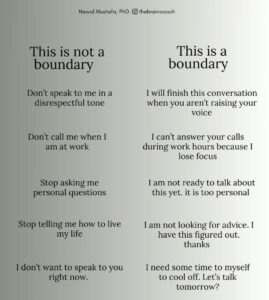
Here’s the side-by-side (screenshot above):
“This is NOT a boundary.”
- Don’t speak to me in a disrespectful tone.
- Don’t call me when I am at work.
- Stop asking me personal questions.
- Stop telling me how to live my life.
- I don’t want to speak to you right now.
“This IS a boundary.”
- I will finish this conversation when you aren’t raising your voice.
- I can’t answer your calls during work hours because I lose focus.
- I am not ready to talk about this yet; it is too personal.
- I am not looking for advice. I have this figured out, thanks.
- I need some time to myself to cool off. Let’s talk tomorrow.
See the shift?
Left column = “You must change.” Aka, it often tries to control the other person.
Right column = “Here is what I will do to protect my well-being.” Aka, it owns its own limits with clarity and care.
At Plumitif Empowerment Academy, this exact distinction lives at the heart of our Interpersonal Effectiveness Skills & Communication module and our Self-Esteem focus area. We teach teens and adults how to set boundaries that work while staying true to who they are. Because when you learn to set true boundaries, you stop leaking energy, stop people-pleasing, and start GLOWing — Growth in Emotional Resilience, Life Skills for Independence, Ownership of thoughts and emotions, and Well-being through healthy habits & self-care.
But here’s the part that hits harder for many of us from Asian, Indian, African, or other collectivist family backgrounds:
When “I need space” feels like you’re betraying your entire upbringing.
In many of our homes, respect for elders, family harmony, and “not rocking the boat” were survival skills, not just values. Saying “no,” asking for privacy, or putting your emotional needs first can trigger a wave of guilt, anxiety, and overthinking that feels physically heavy.
Nagging thoughts like the following might inundate us:
- “Am I being selfish?”
- “Will they think I don’t love them?”
- “What if I’m breaking tradition?”
- “They sacrificed everything for me — how dare I set a limit?”
That internal storm is real. And it’s not a weakness. It’s the complex and lovely nature of being taught to prioritize family, seeing oneself as part of the family unit rather than a distinct individual. We’ve seen it in scenarios like teens freezing when a parent asks, “Why are you closing your door?”, or adults who sacrifice their dreams because it doesn’t align with what the family wants.
Know that you’re not broken, and you’re not being disrespectful by thinking outside of the familiar norm. You are simply learning a new skill that your parents’ generation rarely had language for.
Why Most People Get Boundaries Wrong
We confuse boundaries with ultimatums because:
- We were never taught the difference (hello, school systems that skip emotional literacy).
- Guilt whispers, “If I say no, I’m mean.”
- Trauma or anxious attachment makes us believe our needs are “too much.”
Some of us have likely heard or said things like, “I just freeze up when my friend overshares,” or “I let my partner vent for hours even when I’m exhausted.”
And then what?
We don’t know what to do.
The good news? Boundaries are a skill, not a personality trait. And we teach it with the same evidence-based toolkit we use for everything else: DBT, CBT, ACT, Positive Psychology, and Mindfulness.
4 Psychology-Backed Skills to Set Real Boundaries (That Actually Stick)
1) Own Your “I” — The DBT DEAR MAN Foundation
Instead of “You always…” use the DEAR MAN script (Describe, Express, Assert, Reinforce, stay Mindful, Appear confident, Negotiate).
For example: “I feel overwhelmed when conversations get heated after 9 pm, so I will step away and we can talk tomorrow when we’re both calm.”
And if you’re talking to a parent and need to keep stricter cultural respect in mind, you can try:
“I really appreciate everything you do for me, and I know you’re asking because you care. Right now, I’m feeling overwhelmed and need 20 minutes to myself so I can show up better for our conversation.”
You can role-play with a trusted person, like a friend, family member, or partner. We are looking for respect without resentment.
There’s one thing I always remind my students, and I would like to point it out here: “Just as you have the right to ask, the other person has the right to refuse. We need to practice respect while maintaining our boundaries.”
2) Link Boundaries to Your Values — ACT Style
Ask yourself: “What matters most to me right now — focus at work, peace at home, energy for my goals?” or “What kind of daughter/son/family member do I want to be long term?”
Then build the boundary around that value.
For example: “My value is deep work in the mornings, so I don’t check messages until 10 am.”
Or: “I want to be present, calm, and loving, not always available and secretly resentful.”
No explanation needed. Values make boundaries feel like self-respect, not rejection. A short boundary now protects the relationship for decades.
This is why I’ve emphasized ‘values-building’ so heavily in my curriculum.
3) Reframe the Guilt Thought — CBT Quick Fix
When guilt hits (“I’m being selfish”), catch it and reframe it.
For example: “Protecting my energy makes me a better friend/parent/partner in the long run.”
We do this live in session with thought records and positive self-talk scripts. This skill is particularly beneficial for those who engage in people-pleasing.
4) Self-Compassion Break (Positive Psychology + Trauma-Informed)
Pausing briefly, even for a few breaths, can be helpful to establish your boundaries, assess the situation, and reaffirm your values.
For example, Kristin Neff’s 3-step pause:
- “This is hard right now, and that’s okay.”
- “Other people struggle with this too.”
- “What do I need in this moment?” or “What small kind thing can I say to myself right now?”
Then reframe the thought. For example, “Setting this limit is actually me becoming the strong, emotionally healthy family member they raised me to be.”
Your Go-To Formula for Healthy Boundary Setting:
The PEA “I Own My Peace” Boundary Formula: We often teach this 4-step script in groups because it feels respectful and powerful, especially when your upbringing makes a direct “no” feel like betrayal or disrespect.
Step 1—Warm Opener: Start with appreciation or love. This honors your values and softens the moment.
Step 2—Clear “I” Statement: Speak from your experience only. No blame.
Step 3—Specific Action: This is the real boundary — you’re stating what you will do, not demanding they change.
Step 4—Hopeful Bridge: End with connection. This keeps the relationship warm while protecting your energy.
Try the template tonight: “I [Warm Opener], and right now I [Clear “I” Statement] because [reason], so I will [Specific Action]. Let’s [Hopeful Bridge].”
Print it, stick it in your mirror, save it in your phone notes. The more you practice, the less guilt you’ll feel.
Real-Life Practice You Can Start This Week
At Plumitif Empowerment Academy, we like to end each session with a homework assignment. This helps reinforce the skills being taught.
Here are some examples I recommend you do to build your boundaries:
- Journal Prompt (5-10 minutes tonight)
For example: “What is one situation that leaves me feeling drained or resentful? What would a true ‘I’ boundary look like?”
Layout: “One situation with family that drains me is ________________. A respectful ‘I’ boundary could sound like ________________.”
2. Micro-Boundary Challenge
Choose ONE low-stakes boundary this week. You can even pick one from the right column (the ‘This is Boundary’ section) and use it this week. Text it, say it, write it. Notice the guilt… and notice it passes. And notice how your body feels afterward (usually lighter).
3. Self-compassion reminder (repeat as needed):
“Protecting my peace is how I show up as my best self for the people I love.”
4. Role-Play Safety Net
In our Daily Boost or Weekly Focus groups, we practice these live with cameras on, while advocating for a safe space with immediate feedback. No judgment, just growth. You can do the same by joining the group, or by asking your close friends/family/partner.
Ready to Stop Leaking Energy and Start GLOWing?
Setting boundaries does not mean you love your family less. And healthy boundaries are not walls. Rather, they are doors with clear handles. They let the right people in and protect what matters most. It means you’re learning to love sustainably — without burning out, without resentment, without losing yourself.
If you’re tired of explaining yourself, over-giving, or walking on eggshells, our virtual psychoeducation groups, built with teens and adults in mind, are here for you.
- Daily Boost (4x/week) — immersive practice, fastest results
- Weekly Focus (1x/week) — perfect if you want steady progress without overwhelm
Both are live and interactive on Zoom, open-group (join anytime), non-recorded, and packed with exactly these skills.
Book your free 30-minute discovery call today — no pressure, just a genuine conversation about where you are and how we can help you GLOW.
Remember you:
- Are allowed to do it even when it feels scary.
- Are allowed to say it kindly.
- Deserve relationships that feel good.
- Deserve peace that lasts.
- Are allowed to own and protect your energy.
Let’s make it happen.
With care,
Lavinia Dasani, MBA, GMBPsS, BSc (Hons) Psychology, Certified Trauma-Informed Coach & Founder, Plumitif Empowerment Academy
P.S. Tag someone who needs this post. And save it — you’ll want to come back to the script list when that moment arrives.